
News
Rental Property Tax in New Zealand – What Every Investor Should Know


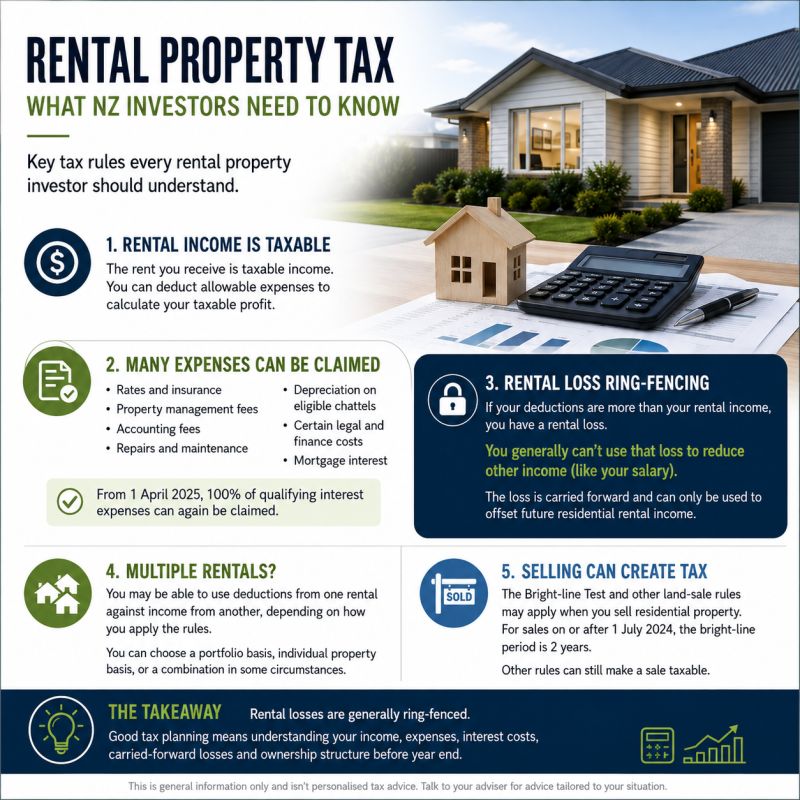
Here are some of the key things rental property investors need to know:
> Rental income is taxable
The rent you receive generally needs to be declared as income. From this income, you can deduct allowable rental property expenses to calculate your taxable profit.
> Many rental expenses can be claimed
Depending on your circumstances, deductible expenses can include:
> Rates and insurance
> Property management fees
> Accounting fees
> Repairs and maintenance
> Depreciation on eligible chattels
> Certain legal and finance costs
> Mortgage interest
Importantly, from 1 April 2025, 100% of qualifying interest expenses can again be claimed, provided the normal deductibility requirements are met.
But here's the big one – Rental Loss Ring-Fencing
This is something every property investor needs to understand.
Imagine your rental receives $30,000 of income, but you have $35,000 of allowable deductions.
You've effectively made a $5,000 rental loss for tax purposes.
Years ago, you could generally use that loss to reduce tax on other income, such as your salary.
You generally can't do that anymore.
Under the residential rental property ring-fencing rules, your deductions are generally limited to your residential property income.
That $5,000 excess deduction is carried forward and may be available to offset residential property income in future years.
So if your property makes a $10,000 taxable rental profit in a future year, your carried-forward deductions may be available to reduce the amount that's taxable.
If you own multiple rentals, things get interesting
Depending on how you've chosen to apply the rules, you may be able to use deductions from one rental against income from another rental in your property portfolio.
IRD allows investors to use a portfolio basis, individual property basis, or a combination in some circumstances. The choice can affect how excess deductions are treated, particularly when properties are sold.
Selling can create another tax issue
The Bright-line Test and other land-sale rules also need to be considered when selling residential property. For properties sold on or after 1 July 2024, the current bright-line period is 2 years, although other land-sale rules can still make a sale taxable even when bright-line doesn't apply.
The takeaway?
Don't assume that because your rental property made a tax loss, you'll receive a tax refund against your salary.
Rental losses are generally ring-fenced.
Good property tax planning means understanding your rental income, deductions, interest costs, carried-forward losses and ownership structure before the end of the financial year.
Talk to us if you'd like help understanding the tax position of your rental property.
Please note this is general information only and isn't personalised tax advice.